Poetry: Azeem

It’s National Poetry Month and here is my favorite poet of the month.   Azeem.  We see a lot of writing about cute poets with education credentials and then someone like this brilliant Azeem fellow comes along and says a few things into a camera and reminds everybody that poets can shoot word bullets. I watch this video and my heart starts pumping and I get fidgety and I want to leave my chair and get to know words as well as this guy knows them.  I noticed Azeem because he is one of the few subscribers to my YouTube film channel and so I checked him out.  I’m extremely impressed.  You want people to be interested in poetry?  Show them this guy and they’ll be interested in about 5 seconds flat.  I think what makes most poets uninteresting to the American reading public is that they all secretly have an image of a bookshelf in mind.  Bookshelves are fine if you are browsing for a book, but they are death for anyone who’s making something.  Azeem is also working with some hugely talented filmmakers who make fantastic imagery and do it with ease.  If he comes to Los Angeles, I want to know about it and go see him play.

Set a Blaze:

Read the rest of this entry »


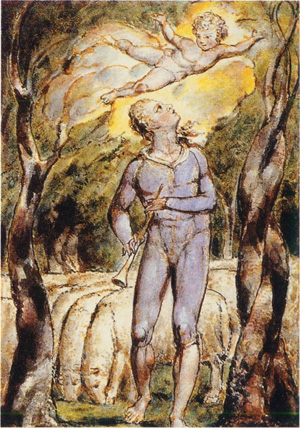
William Blake: Songs of Innocence

DOWNLOAD MP3 AUDIO

Piping down the valleys wild,
Piping songs of pleasant glee,
On a cloud I saw a child,
And he laughing said to me:

‘Pipe a song about a Lamb!’
So I piped with merry cheer.
‘Piper, pipe that song again.’
So I piped: he wept to hear.

‘Drop thy pipe, thy happy pipe;
Sing thy songs of happy cheer!’
So I sung the same again,
While he wept with joy to hear.

‘Piper, sit thee down and write
In a book, that all may read.’
So he vanished from my sight;
And I plucked a hollow reed,

And I made a rural pen,
And I stained the water clear,
And I wrote my happy songs
Every child may joy to hear.

Songs of Innocence and of Experience was written and illustrated by English poet, painter and printmaker, William Blake in 1794.  This poem is the introduction to the book.  Seems pretty simple when you read it.  But if you stare at it long enough, it gets really interesting.


I’m Gonna Beat You With My Poem

I’m about to show you why I have so few friends.  It’s because I don’t put up with ‘team mentality.’  Hey kids, come over here and join my poetry team!  Yeah dudes!  Get with it!  Get hip to my dang poetry team, bro!  We could win!  We could take the whole prize, sista!  Yeah, baaaaaaby!

I’m the kid eating the Twinkies, picking my nose, twirling the Frisbee on my finger and looking at you like you’ve got a gun.  That’s me.  You scare me, poetry dude.

For some reason, in our young national culture, we enjoy teaching our children to compete via talent shows of all stripes.  Since it’s National Poetry Month, the Louder Than a Bomb demo video caught my somewhat jaundiced eye.  I put up with it all the way through even though it made me squirm.  Poetry as in your face talent competition doesn’t fit my world view.

Right away the video starts out with total obnoxiousness.  The guy says, ‘We de-emphasize the competition, but you want to win!’  A-hole.  What an idiot.  Kids, remember, always run from a guy that says something like that.  Run and don’t look back.

I feel the same way about film festivals, American Idol, Dancing with the Stars and the Academy Awards.  I even feel the same way about online writing contests, though I’ve hosted them myself.  They are intended to boost traffic on a web site.  They serve no real purpose and offer no true value at all.  Contests are held to make mediocrities feel like they can hand out prizes.  A kid who is going to be a poet is going to leave by the back door every time.


National Poetry Month – April 2010

It’s almost here.  April will be National Poetry Month, during which we celebrate the placement of words into various shapes, patterns and meanings that only a select few can decipher.  Don’t worry, if you saw the poetry reading at the most recent Presidential Inauguration, she was only placed at the podium to intercept bullets.  That has nothing to do with poetry.

For those of us fortunate and intelligent enough to avoid the study of poetry in a university, the month of April can be a strangely rewarding treat.  It’s an awkward and sort of a lame month of celebration, but it works.  Don’t ask me why.  Just think of yourself as being in the National Poetry Month and walk into a good bookstore and go to the poetry shelf to see what happens.  If you’re a total dumbass, nothing will happen of course.  But if you can read, you might start wondering why words make you want to have a coffee, or a piece of bread, or some wine, or cheese, or wear a hat, or some old boots.

I think I am going to celebrate Poetry Month by posting parts of my unfinished new video.  It mixes images, music, and words to make something that can really only be explained in terms of poetry anyway.  So I claim the right, during National Poetry Month, to be somewhat mysterious, cryptic, unfinished, insulting, fuzzy, indulgent, and unintelligible.


Film: Typography

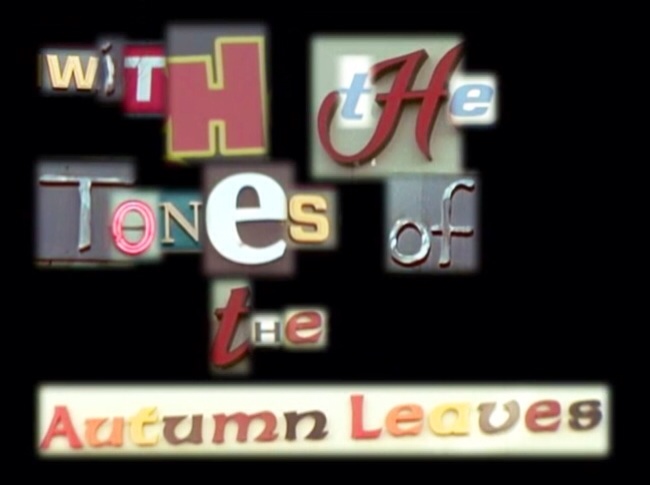
In Ronnie Bruce’s short film Typography, poet Taylor Mali lets it all hang out about how people talk today. Hipsters. Kids. Cooliodoolios who don’t want to sound too committal about anything. Every utterance is just a little fart with a question mark at the end. ‘You know?’

I don’t happen to have this problem with sounding non-committal and all like you know laid back. I get in trouble because I talk too much like a guy who’s swinging a baseball bat. But, uh, you know, in an era of fake Bush wars and a ‘liberal’ president who tells me I’m going to have to buy insurance from a murderous private company or else… well, hmmm, like, dude, I’m swingin’ my verbal bat just as hard as I want and I’m hoping to hit someone in authority. The Tea Party folks are idiots, but there’s one thing they’ve got right. Obama is so over, he’s, like, you know… done.  Obama reminds me of a school principal.  Never says anything worth listening to.  He’s got the dullest eyes I’ve ever seen on a president.  Notice that?  Blank.  Even Bush had expression.  Always terror.  Sheer stark raving terror radiated out of Bush’s little monkey eyes.  Obama radiates the pause between pre-planned comments – the ‘umm’ moment.

Of course, when people suddenly get very clear, direct, self-assured and forceful in their statements you know what happens, right?  You get Hitler.


CAConrad – Wicked Philadelphia Poet on a Roof

Mature Poetic Content: If you think this shouldn’t exist here in this site, well… sorry, but this site switched tracks long ago. You just didn’t know it.

When I see a recitation
from a poet
I want to intervene
Drag him into a street fight
Crack a crutch
across his head
It’s attempted
resuscitation

~Editor

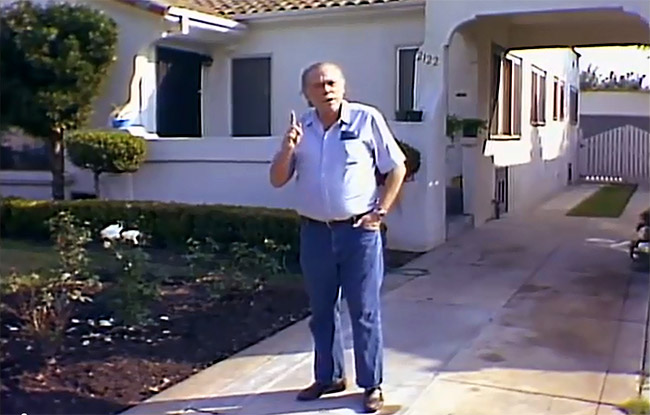
Well, I think I’ve just been punched in the mouth. Wouldn’t have it any other way. I keep looking for mean mad poets. This guy’s one I think. He’s doing his Beatles impersonation on a frozen roof in Philadelphia and he’s wearing purple. He seems to be someone who could knock me down and I’d know I’d been treated gently. This guy’s poetry sounds wicked and mad and full of love at the same time. It’s the kind of thing I’d read over and over again. His poetry is like something he’d say in a room without thinking much about it. I love the thing about Poe and his bones and Frank answering in a different voice at the 10:50 mark. Ha ha! Love that. That’s what it’s all about isn’t it? Saying it back as if you’re the guy. It’s how you travel in time and make magic happen. It’s the hidden art. I know a lot about that poem. So, okay, there’s a poet in Philadelphia who’s not afraid of the snow and keeps a fur hat on top of his head. I’ll be looking for this guy and reading his books.  He’s CAConrad.  You can buy his The Book of Frank here.

I found this via the ever-pernicious Silliman’s Blog.


Poetry Is? It’s a Stupid Question, That’s What.

In my poetic web adventures I went and found this big long movie by George Quasha about poets trying to tell everybody what poetry is. What is poetry? It’s not an unanswerable question. It’s a stupid question. But these poets do try to answer it. It’s a rather long movie and I always look for a bad guy in every movie. Without a bad guy, a movie just makes me hungry and I get up to go to the bathroom a lot. These poets are all so nice and content looking. So friendly and comfortable. I can’t find out which one is the bad one. Someone once asked me a really stupid question and I ran away with his camera and threw it in the river. Why aren’t any of these poets nasty and depressed? What makes them so pleasant? They all sound like their favorite piece of furniture is a podium.

Here’s a guy who if you ask him what poetry is will very likely give you a good reason to never ask that question again:

Get what I mean?


Filmmaker Jonas Mekas on Living in Poetry

This is a clip from a documentary film, Meanwhile, a butterfly flies, about filmmaker Jonas Mekas. He shares a few thoughts about culture, country, poetry and what those things really are.


Planisphere: New Book of Poems by John Ashbery

PlanispherePoet John Ashbery has published a new book of poems called Planisphere.  Boy, I hated this guy’s poems a few years ago.  But I kept reading them because of some instinct for self-inflicted mental damage.  And I kept reading him.  Not understanding him at all.  But I liked the words as they passed me by.  They sort of slide on by you.  Smooth, but switching and becoming something totally unexpected, unrelated to what just happened before.  His poems sort of shimmer and seem a bit brittle, like glass.  When you read this guy you certainly know that you are not reading someone else.  He’s in his eighties, but his work seems like a young man’s.  He has a gently rebellious foolishness that I greatly admire.

His publisher, Harper Collins, has a preview of his new book that offers quite a few of the poems.

So does this sound like the writing of an eighty-year-old?

I dream of married couples having sex, shopping, everything,
and often get the giggles, staying here,
expecting something new to come along every five seconds.
That’s new to me, I expect others will have heard about it.

B—’s Mysterious Greeting

And here’s the guy:


Poem: Number Crunchers Adore Me

I am a clipped in user
of information keyed and shining
on a glass partition with an ascending
staircase behind the twitching
lozenges

My fingers hunt
the sleek and they twirl
along the draped wires
to find the pressed-in
prong which is
bent

You cannot throw me
or catch my attention
from the sideview
just remember
that I passed the pickup
and won

Number crunchers adore me
because the arguments
are bluffing really
people don’t use them
without qualifications


Remember the Book?

LeavesOfGrassBookRemember the book?  Of course you do, because you have plenty of them in shelves, half-read, dusty, bent, torn, coffee-stained, wine-colored, smudged, smelly, misprinted, broken and cherished. They catch your glance as you walk from one room to another, reminding you of a year or a moment when you were doing something else but had that book in your bag or backseat and meant to finish it or did in fact, and put it away and moved it several times in a box, cursing its weight and trying not to bend it.  So there it sits now, quite possibly closed until the day you die.  But you know it’s there and it’s a marker in your life.  Remember this thing with books?

And LPs of vinyl?  Mine used to function like books in my shelf.  But I put them into a closet years ago because of CDs.  Now I can’t stand searching a shelf of CDs, so I mainly use MP3 files.  My albums no longer work as markers of life and time.  The same thing is happening to books.  All of mine are still on the shelves.  But the world is changing and books are beginning to look a lot like information that wants to weigh less. It doesn’t matter how one feels about this, whether it makes us sad or not.  It’s a creeping fact.  Our books are turning into wonderful collector’s items. I can tell this is happening partly from all the excitement and business surrounding these e-reader devices.  Books will continue to play an important role in literature but they will gradually be eclipsed by some other technology.  The current e-readers are not necessarily it, but they are the harbingers of things to come.  We are lightening our load because we can’t carry it around forever.  We’ll have to travel light.  Walt Whitman wouldn’t mind though, because he’d want to travel with us.

But this fellow, Raymond Danowski, has amassed the largest collection of 20th Century English poetry books in the world.  He collected over 70,000 books, periodicals, and artifacts.  The collection includes a first edition of Whitman’s Leaves of Grass, printed by the poet himself.  It also has a first edition of T.S. Eliot’s Prufrock and Other Observations.  There are so many books that when he donated the entire collection to Emory University in Atlanta, it took volunteers over a year just to unbox all the volumes.  The university is now the major center for researching 20th Century English poetry books.

I’d like to see that collection.  It must be fascinating.  And anything is worth touching that Walt Whitman touched.  Seeing books is the thing.  They have a presence in a room, lining its walls and giving it enormous depth.  But we are engaged in a process of making our books invisible.  What will we put in their place?  I’m not really too worried about that because when you turn all those words into digital form you present yourself with infinite possibility.  When words float around in the air you are in the realm of magic beyond anything any book could have ever accomplished.  Then again, sometimes just touching a book is enough to send your mind wandering down an unexpected path.  Can touching a virtual keyboard have the same effect?  Does it have to have the same effect?  Maybe not.  I’m sure banging a chisel into a clay tablet did things to a mind that ancient peoples were loath to part with.

Does the emergence of a world without books frighten or worry you?  Do you see something wrong with a world in which literature is simply information that travels wirelessly?  Do you think that ink is inherently superior to bits?

Eventually, we will read War and Peace by passing someone on the street and glancing into their eyes for a brief moment.  That person will give us the book as nothing more than a polite ‘How do you do?’  At that point, we will remember books the way we remember the clay tablet.


Poem: Each Night I Go to Bed

by Lethe Bashar
The poet is the editor of Escape into Life, arts/culture web-zine and fine art auction. He is also working with an illustrator from Argentina on a graphic novel. Besides that he keeps up an essay-blog, The Blog of Innocence, that covers topics in the arts, social technology, and a general philosophy of life.

This poem was originally posted on Twitter as an experimental project in spontaneous poetry via Twitter with @paulokoba

Each Night I Go to Bed

each night I go to bed
a little bit later
I wake up in the morning
forgetting the past

days add up like coins in my pocket
I’m rich with hours
another little bit has passed

I find another hobby
swear to myself I’ll get healthy
another little bit has passed

I think about the news
write about my views
another little bit has passed

when will this world come to an end?
it seems so eternal right now


Poem: The Moth Approached Me Like a Blinking Eye

by Lethe Bashar
The poet is the editor of Escape into Life, arts/culture web-zine and fine art auction. He is also working with an illustrator from Argentina on a graphic novel. Besides that he keeps up an essay-blog, The Blog of Innocence, that covers topics in the arts, social technology, and a general philosophy of life.

The Moth Approached Me Like a Blinking Eye

The moth approached me like a blinking eye,
I was having a cigarette in the garage.
The birds squeaked in the far off darkness,
a menacing sound disrupting the night.

I pressed the moth to give me her reasons
for staying up as late as she did–
She continued to blink, and I awaited her answer,
but nothing came.

The birds heckled the darkness and the darkness
heckled back–the chaos persisted but
remained subdued and the neighbors
stayed in bed.

The children, in their warm beds,
were dreaming of magical places,
and I bemoaned my condition
while having my cigarette in the garage.

I thought of summer, which was expected
to come, maybe tomorrow or never,
I figured I’d be sleeping when it did.
I thought of the hours I’d missed.

The moth returned after awhile,
she blinked her wings again and again,
She seemed to know I had a mild fever,
she seemed to know my memories too.

Let me go, I said. Be off. I want to sleep.


Charles Bukowski Meets Another Poet

bukowskiThe Rumpus has a piece that Charles Bukowski wrote as a forward to a book of poems by William Wantling in 1974.  He writes about meeting the other poet for the first time and liking him.  It must have been a big thing to be liked by Bukowski because he seems to have a problem with most people.  His piece is touching and shows how sensitive Bukowski really was to the unspoken things.

He writes a bit about style and says:

Style means no shield at all.
Style means no front at all.
Style means ultimate naturalness.
Style means one man alone with billions of men about.

Is that really it?  Boy, Bukowski would have hated me to the ends of his toes because I’m always arguing my point.  The problem I have with what he’s saying there is that he made a living by writing with the biggest shield of all in front of him.  A bottle.  It’s the best shield there is.  Bullet-proof.  So he must be wrong about style.


New Film: Lunch With Bardot

My latest little film. It’s actually a cinegram. The subject is trains. Time. Memory. The present doesn’t exist. You can’t find it with measurement. You can’t even define it. The future is not there yet. You cannot see it. The only thing that really exists is the past. I say that because we can all see the past – some more clearly than others. But we can most certainly see it.

A cinegram is a short motion picture that uses images and text that are packed with meaning and suggestion. It’s my new word for things I once referred to as film poems.

Here’s the poem from inside the movie:

Lunch With Bardot

Trains run on time
With passengers asleep
Temporarily forgotten
Between observation points
Colliding lines
Of fictional transport


Hear Walt Whitman Reading His Poem ‘America’

The Walt Whitman Archive has a 36-second recording taken from an old wax cylinder of what is thought to be Whitman himself reading four lines from his poem, America.

Listen to Walt Whitman reading America

Here’s the text of the poem:

America

Centre of equal daughters, equal sons,
All, all alike endear’d, grown, ungrown, young or old,
Strong, ample, fair, enduring, capable, rich,
Perennial with the Earth, with Freedom, Law and Love,
A grand, sane, towering, seated Mother,
Chair’d in the adamant of Time.


A Little Poetry Contest: The Winner

the-poor-poet

DOWNLOAD MP3 AUDIO

Sascha Cooper is our Little Poetry Contest winner.  Her poem, A Blank Canvas, is a meditation on the power of creativity in normal surroundings.  We didn’t get many poems for the contest so it only makes sense to pick a single winner.  Perhaps more poets will want to enter the next Little Poetry Contest.  But this poem would stand out in any group of poems.  Actually, I was quite surprised to receive a poem this good during the very first contest.

You can listen to the winning poem with the player above while you read it here.

A Blank Canvas

Inspiration comes from all seeing eyes.
Let the imagination run wild
With all colours that light up at night.

Outside the window looms a palace
With domes that stretch up to the sky.
Stuck in time, yet current;

Transporting me back to a time of
Princes, kings and queens.
Arabian nights coax and tempt me.

Back in the land of reality,
The box is blaring, mum is cooking
And my best friend is next to me.

The computer is on a small table
That was a shelf – makeshift, but handy.
Drink and numerous papers at my side.

White walls, sleek lines;
Carpet that’s light and not right,
Sliding doors of black and silver.

All this in a box of glass
Ready to be personalised.
A blank canvas.


Audio Poem: Ode to a Nightingale

491px-john_keats_by_william_hilton

DOWNLOAD MP3 AUDIO

For the last day of National Poetry Month 2009, here’s a reading of Ode to a Nightingale, by English poet John Keats.  It was written in 1819 after the poet had been listening to a nightingale in the yard of a friend one morning.

Here is the text of the poem:

My heart aches, and a drowsy numbness pains
My sense, as though of hemlock I had drunk,
Or emptied some dull opiate to the drains
One minute past, and Lethe-wards had sunk:
‘Tis not through envy of thy happy lot,
But being too happy in thine happiness, -
That thou, light-winged Dryad of the trees,
In some melodious plot
Of beechen green and shadows numberless,
Singest of summer in full-throated ease.

Read the rest of this entry »


Podcast of Henry David Thoreau on Poetry and Writing

486px-henry_david_thoreau

DOWNLOAD MP3 AUDIO

In 1839, Henry David Thoreau and his brother made a river voyage in a boat that they built themselves. This voyage became the subject of Thoreau’s first book, A Week on the Concord and Merrimack Rivers, published in 1849 at his own expense. In this thirty-three minute excerpt, Thoreau finds himself describing the incredible beauty and serenity of the natural scene around him. But his mind wanders into a profound examination of poetry and the requirements of good writing. His call to man for a life of poetry and his demand that writers create simply from an impulse to action are powerful and true. I don’t think there is a better piece of advice that exists for writers and readers alike.

Thoreau frequently quotes from Homer’s Iliad and other sources in this piece. I have tried to separate his quotes with pauses and a change in reading tone. You might want to glance at the actual words as you listen for clarification.

Here is the text of the reading:

What would we not give for some great poem to read now, which
would be in harmony with the scenery,–for if men read aright,
methinks they would never read anything but poems. No history nor
philosophy can supply their place.

Read the rest of this entry »


Poetry Through the Ages

penandpaperPoetry Through the Ages is an excellent site that offers clear and concise explanations of different poetic forms, a general history of poetry and a simple guide to reading and appreciating difficult poems.

“When a poem arises, it feels like the bosom of the poet lifts up and births the spoken or written moment. The point of origin lies at the furthest depths of the poet, often calling into play ancestral memories, divine or universal inspiration, and insights or truths that “magically” resonate with the reader.”